

Research & Academic Analysis
Protecting Workers in the Age of AI: A Systems-Change Perspective
Overview
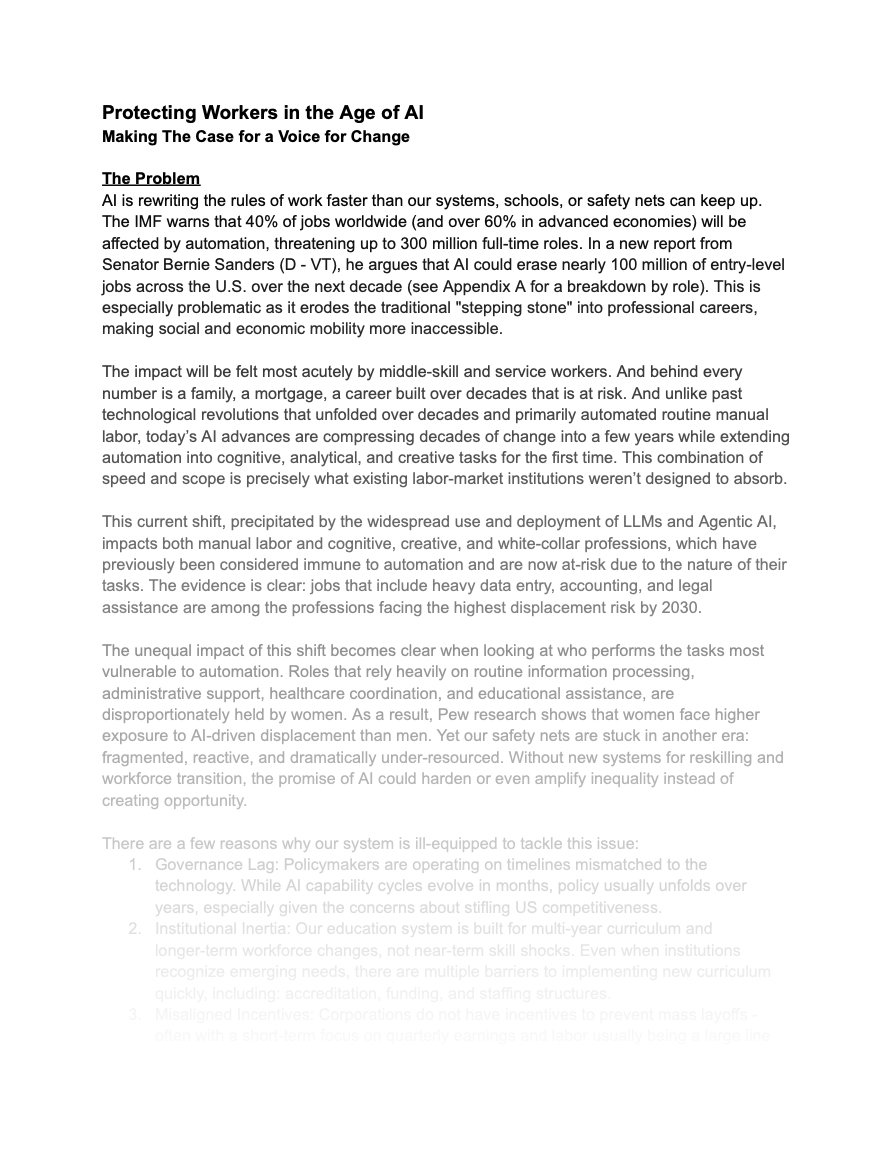
Voice For Change Foundation was the subject of an academic research paper written at Harvard Business School as part of the Social Entrepreneurship and Systems Change course. The paper examines the rapid acceleration of AI-driven job displacement and evaluates whether existing workforce systems, educational pathways, and policy institutions are equipped to absorb this disruption.
Rather than framing job loss as an individual failure to reskill, the research analyzes AI-driven displacement as a systems-level breakdown—where governance lag, institutional inertia, and misaligned corporate incentives leave workers exposed during periods of rapid technological change.
The Problem the Research Examines
The paper identifies several converging dynamics reshaping the labor market:
Artificial intelligence is automating not only manual labor but cognitive, analytical, and creative tasks, compressing decades of workforce change into a few years.
Entry-level and “stepping stone” roles—critical for economic mobility—are eroding faster than new pathways can be established.
Middle-skill and service roles face disproportionate displacement risk, with women more exposed due to task composition.
Existing workforce systems were designed for incremental change, not rapid, cross-sector disruption driven by AI and agentic systems.
Safety nets, reskilling programs, and governance structures remain fragmented, reactive, and under-resourced relative to the scale of the shift.
Why Voice For Change Foundation Was Studied
The research positions Voice For Change Foundation as one of the few organizations explicitly focused on worker-level consequences of AI adoption, rather than AI ethics or long-term economic modeling alone.
Key characteristics highlighted in the paper include:
A policy-first theory of change, recognizing that retraining alone cannot protect workers when skill demand is unstable.
Development of frameworks such as the Workforce Resilience Framework and Fair Hiring Blueprint to address AI-driven displacement upstream.
A dual strategy combining policy advocacy with public narrative change—reframing job loss from personal failure to collective responsibility.
Founder proximity to the problem, grounded in lived experience navigating AI-driven displacement firsthand through a saturated hiring landscape.
Key Research Insight
When the future demand for skills is highly uncertain, reskilling alone cannot provide durable worker protection.
As technological change accelerates, skills-based pathways—such as coding bootcamps or narrowly defined retraining programs—risk funneling workers into roles that may disappear before returns on training are realized.Sustainable workforce resilience therefore requires policy, fiscal incentives, and governance frameworks that evolve at the pace of technological change, not just faster reskilling. These frameworks must guide how labor markets absorb disruption, how education aligns with long-term economic needs, and how risk is shared between workers, employers, and the public sector.
This insight emerged repeatedly during classroom discussions, particularly around failed reskilling pathways such as the decline of entry-level software engineering roles and the limits of bootcamp-driven workforce transitions.
A Systems-Change Approach
Using systems-change frameworks taught at Harvard Business School, the paper evaluates Voice For Change’s work across three levels:
Structural change:
Adoption of workforce resilience policies, AI governance requirements, and employer accountability mechanisms.Relational change:
Shifting power dynamics between employers, workers, training providers, and policymakers.Mental model change:
Reframing workers as long-term assets rather than disposable cost centers in AI-driven transitions.
The research argues that meaningful progress requires alignment across all three levels—not isolated interventions or short-term retraining programs.
Risks & Constraints Identified in the Research
The paper outlines two primary risks:
Pace mismatch risk:
AI adoption cycles are moving faster than policy and institutional response, threatening to outstrip available protections for workers.Political and economic volatility:
Workforce policy depends on shifting political priorities, economic cycles, and corporate incentives, creating uncertainty in implementation.
Despite these risks, the research identifies emerging momentum—particularly at the state level and through reporting and accountability proposals—as potential leverage points for change.
About the Research
This analysis is based on an academic paper written by Karen Alpuche, MBA Candidate, Harvard Business School (Class of 2026), as part of the Social Entrepreneurship and Systems Change course.
The paper is shared on this site with the author’s permission.
Views expressed in the research are those of the author and do not represent institutional positions of Harvard Business School.
Download the research paper here.