

The Economic & AI North Star (2025–2035)
A Governance Framework for Aligning Artificial Intelligence with People, Work, and Economic Stability
Executive Orientation
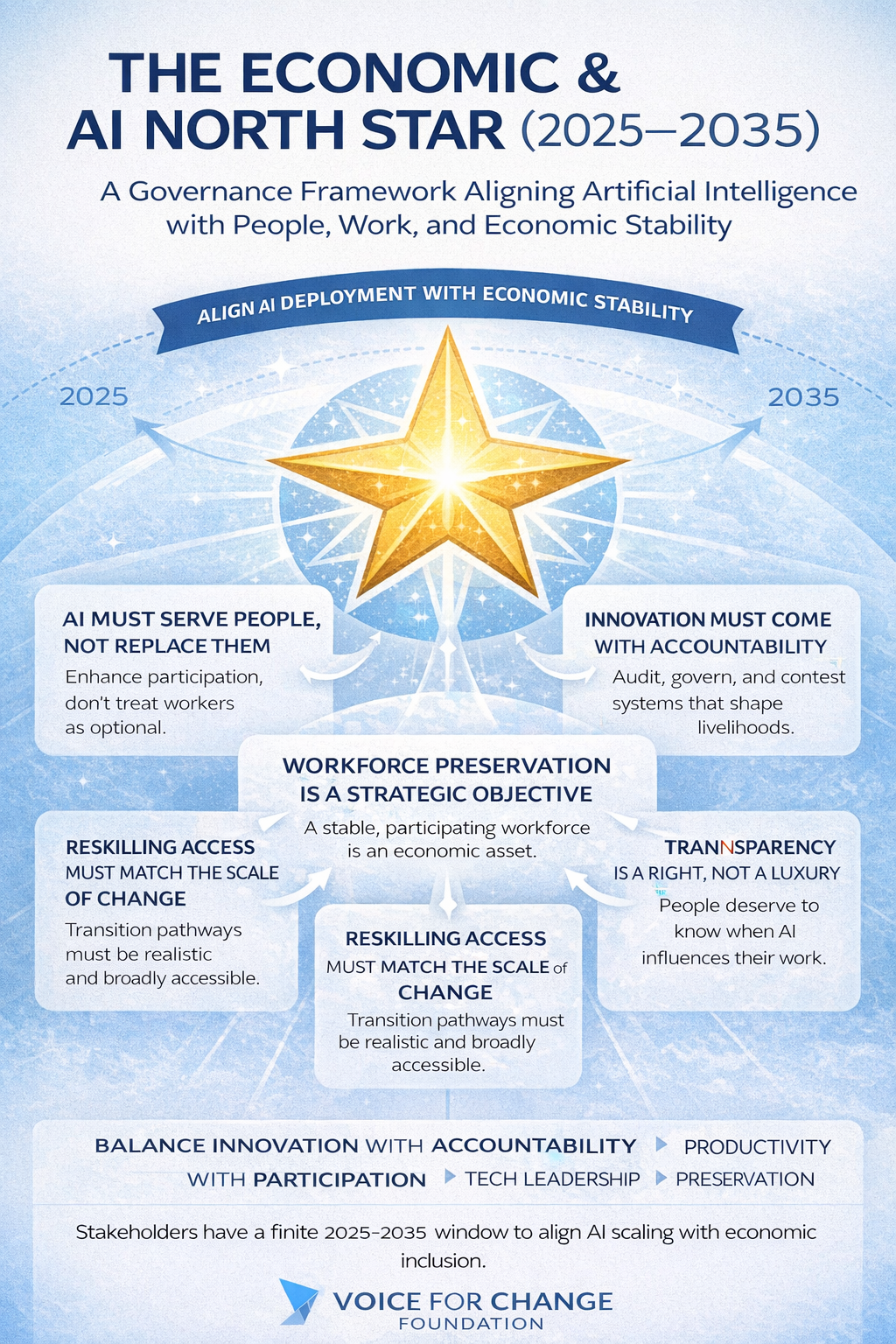
The Economic & AI North Star (2025–2035) is a governance framework designed to guide how artificial intelligence is deployed across the U.S. economy during a decisive decade of transition.
Artificial intelligence is no longer a peripheral technology. It now shapes how people enter the workforce, remain employed, and participate economically. While AI capability has advanced rapidly, workforce policy, institutional readiness, and governance clarity have not kept pace.
This framework exists to provide orientation, guardrails, and strategic clarity—not to slow innovation, but to ensure it scales in ways that preserve workforce participation, economic stability, and public trust.
Why This Framework Exists
AI is already embedded across hiring systems, productivity tools, performance management, financial decisioning, and public-sector operations.
What has not evolved at the same pace:
workforce policy,
institutional readiness,
governance norms.
Without a shared orientation, incremental and uncoordinated deployment decisions risk producing large structural effects—often recognized only after they become difficult to reverse.
This framework exists to:
surface systemic risks early,
clarify tradeoffs,
and define principles that support both innovation and economic participation.
The Core Risks (Beyond Sci-Fi)
The most consequential risks posed by AI are not sudden or cinematic. They are systemic and cumulative.
They appear most clearly in employment and workforce systems, where:
AI-mediated hiring operates without transparency or appeal;
jobs are redesigned or automated faster than workers can realistically transition;
productivity gains scale without corresponding workforce investment;
entry-level and middle-skill pathways narrow;
decision power concentrates in opaque technical systems;
policy lags behind deployment realities.
These dynamics do not imply malicious intent. They reflect speed mismatches between technology and institutions.
Recognizing them early enables correction without crisis.
The Window of Influence (2025–2035)
The coming decade represents a real but finite window of influence.
Between 2025 and 2035:
AI deployment patterns will harden into norms,
governance defaults will be set,
economic expectations will recalibrate.
This window is not about stopping AI.
It is about governing deployment choices before they become irreversible.
If acted upon:
AI can function as a multiplier of human work;
workers can transition with real institutional support;
transparency and accountability can coexist with innovation;
economic participation can broaden rather than contract.
If ignored:
inequality deepens,
labor mobility declines,
trust erodes,
economic volatility increases.
The future is not fixed. It is being shaped through thousands of decisions made now.
The North Star Principles
At the Voice for Change Foundation, the following principles guide all work related to AI and economic governance:
-
AI should enhance participation—not render workers structurally optional.
-
Systems that shape livelihoods must be auditable, governed, and contestable.
-
A stable, participating workforce is an economic asset—not collateral damage.
-
People deserve to know when and how AI influences decisions about work and opportunity.
-
If AI reshapes the labor market, transition pathways must be realistic and widely accessible.
These principles are pro-innovation, pro-adoption, and pro-stability.
What This Framework Calls For
To align AI deployment with long-term economic stability, this framework supports:
Federal AI governance that balances innovation with workforce protection;
Transparency standards for AI-mediated hiring and employment decisions;
Independent audits of high-impact AI systems;
National upskilling and reskilling programs funded at the scale of the transition;
Public–private partnerships that treat workers as stakeholders;
A coherent national strategy that treats AI as economic infrastructure.
These measures reduce friction, clarify expectations, and enable responsible scaling.
Federal Policy Context: What Must Be Completed
Recent federal efforts seek coherence in AI governance—an important objective.
However, coherence alone does not guarantee workforce stability.
A durable national AI framework must balance:
innovation with accountability,
productivity with participation,
technological leadership with workforce preservation.
Without explicit workforce protections, transparency standards, and transition strategies, federal preemption risks creating clarity without coverage—a regulatory vacuum that favors efficiency over inclusion.
Alignment, Gaps, and Complementarity
Where alignment exists:
recognition that policy fragmentation creates instability,
shared understanding that this decade is decisive,
concern over unprincipled or distorted AI behavior.
Where gaps remain:
workforce impact analysis,
hiring transparency requirements,
appeal mechanisms for algorithmic decisions,
national reskilling strategy tied to automation,
worker representation in AI governance.
These are not ideological gaps. They are structural ones.
The Economic & AI North Star is not oppositional.
It provides the people-first layer required for national AI governance to succeed in practice.
Closing Orientation
AI will shape the economy regardless.
The question is whether deployment is guided deliberately—or governed only after systems harden.
The Economic & AI North Star exists to support the former, while that choice still exists.
Disclosure: This content reflects original human critical thinking, informed and supported by AI-assisted research and analysis.